
Much focus is given to Jesus’s public ministry, including his miracles, teachings, crucifixion, and resurrection. Still, the years before this ministry are also important. The Gospels offer glimpses into Jesus’s childhood and young adulthood. They portray a life that was generally ordinary yet significant.
NAZARETH: A HUMBLE LAND
Jesus grew up in Nazareth, a small town in the Galilee region. It was situated in a basin surrounded by hills, making it somewhat isolated and not on a major roadway. Like many other small villages of the past and today, the population ranged from 300 up to 1,000. The community was close-knit, where everyone knew each other. It lacked the grand structures found in larger Roman or Greek cities. For instance, there were no palaces or bathhouses. Instead, it featured humble homes.
Nazareth was a land of agriculture and livestock: Barley, wheat, olives and grapes; sheep, cattle, chickens’, mules, donkeys and camels. There is also evidence of industries like wine and olive oil production, with presses found in the area. Carpentry was a recognized trade, Joseph was a carpenter, and he would have taught his eldest son the trade. We find reference to this fact in the Bible, like Matthew 13:54-55. Jesus spent years working. He learned the skills of a builder. This included working with wood and stone, given the prevalence of stone construction in the region.
NAZARETH: JESUS’ CHILDHOOD HOME
We know that Mary and Joseph were devout Jews. They raised Jesus in a close-knit, observant family and cared for him deeply. We do not know what their family home was like. Still, we can look at what was common during the early centuries. From this, we get a glimpse of the possibilities. Houses in Nazareth were typically built with stone foundations and mud-brick walls. They were simple and small, often incorporating subterranean rooms or pits carved into the soft limestone for various purposes. These underground spaces served as storage for grains and oil. They also served as cisterns for water. Sometimes, they were even living quarters during the hot summer months. Houses also featured flat roofs, which were used as an extra workspace or for sleeping during warm weather. Cooking was often done in a communal courtyard, utilizing open fires and ovens
What meals did Mary prepare for her husband, Jesus, and his half-siblings? The daily diet was simple and wholesome, centered around staples like bread, legumes, olive oil, and dried fruits. Bread was a cornerstone of every meal and was typically baked daily, often by the women of the household. Vegetables like olives, onions, and various greens were readily available seasonally. Meat was considered a luxury and was primarily consumed during special occasions or feasts. Fish was a more common source of protein, especially for those living near the Sea of Galilee. Wine and water were common beverages, and curdled milk and cheese were also consumed.

JESUS: A YOUTHFUL PRODIGY
The Bible provides little information about Jesus’ formal education. Still, information can be inferred from the Jewish educational system of the time. Extra insights come from references within the Gospels. Jesus was a Jewish boy in Nazareth. He would have attended the synagogue school. The school is known as the Bet Sefer, House of the Book. There, boys aged 5 to 10 learned to read, write, and memorize the Torah. By age 10, many had memorized the entire Torah.
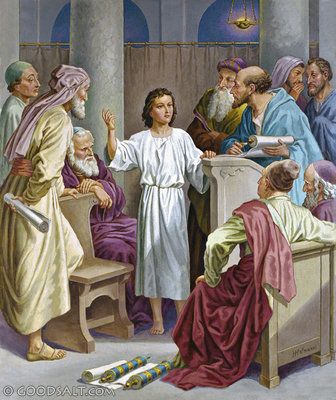
More advanced students would continue their studies at the Bet Talmud (“House of Learning”). Between ages 10 and 14, they studied and memorized all the Hebrew Scriptures. They learned to analyze and debated the scriptures using a question-and-answer method. A few would progress to the Bet Midrash (“House of Study”). They would seek to become a rabbi’s disciple. They aimed to emulate their teacher’s knowledge and lifestyle. This aligns with Jesus’ understanding and questions during his Temple visit at age 12.
pinterest.com/pin/500532946089515407/↗
We already know that Joseph trained Jesus as a tekton, also known as a carpenter, or skilled craftsman. He would have also taught him the business side of the craft. This included business contracts and other aspects necessary for a successful business of the time. The Gospels show Jesus’ literacy, particularly in Luke’s account of him reading from Isaiah’s scroll in the synagogue. Jesus’ ability to speak multiple languages, like Aramaic and Hebrew, shows his education. He knew Greek too. This suggests a comprehensive education within the Galilean culture.
SHAPED BY NAZARETH: HOW JESUS’S EARLY LIFE INFLUENCED HIS TEACHINGS
The Gospels offer a narrow window into the early years of Jesus. Yet, the details they give are merged with historical, cultural, and archaeological evidence. This combination allows us to piece together a slightly larger picture. Each aspect of Jesus’ early life would influence his teachings.
THE HUMILITY OF A CRAFTSMAN
As per cultural norms of the time, Joseph taught Jesus the skills and knowledge of carpentry. This humble background in a small, relatively obscure village nurtured a profound awareness of common people’s everyday struggles. His parables and chreiai, which often referred to everyday life and occupations, resonate with this experience.
A STRONG FOUNDATION IN JEWISH TRADITION
Jesus’s family was deeply rooted in the cultural and religious traditions of Judaism. He grew up in a close-knit family. Participating in synagogue services where Jewish texts were read and discussed taught him values of compassion and service. He was well-versed in the Torah from a young age. This immersion in his heritage profoundly influenced his teachings, grounding them in the rich history and wisdom of his people.

mjhnyc.org/blog/a-torah-scroll-saved-on-kristallnacht/↗
COMPASSION AND SOLIDARITY
Jesus’s teachings often highlighted the importance of caring for the poor and marginalized. This emphasis stemmed, in part, from his own humble beginnings. It also comes from his time as a refugee during his infancy. His actions throughout his ministry, demonstrating compassion for women and those excluded by societal norms, further underscore his empathy.
UNDERSTANDING OF THE COMMUNITY
Jesus grew up within a close-knit community in Nazareth. Through this, he gained an understanding of the importance of community. This theme features prominently in his teachings about the Kingdom of God. He understood the dynamics of social interactions. These were both positive and challenging. This understanding informed his approach to leadership. It also helped in building a community of believers.
A PART OF GOD’S PLAN
In essence, Jesus’s early life before his public ministry was a time of growth, learning, and preparation. It was grounded in family, community, and the work of a craftsman. It reminds us that ordinary lives, lived with faithfulness and dedication, can be just as important in God’s plan. These lives are as valuable as the most impactful moments.
Please feel free to leave a comment and like.
 Society of Grace
Leave a comment